
FHIR has become the de facto standard for healthcare interoperability, but for many healthcare organizations, the journey toward FHIR compliance remains challenging. The biggest hurdle is often not the standard itself it’s the effort required to integrate legacy EHR systems that were never designed with modern interoperability in mind.
Over the years, I’ve seen healthcare organizations invest significant time and resources building custom middleware, integration engines, and transformation layers to bridge the gap between proprietary EHR data structures and FHIR standards. While these approaches can be effective, they often introduce additional complexity, maintenance overhead, and long implementation timelines.
With the rapid advancement of AI and large language models (LLMs), a different approach is emerging.
With the rapid advancement of AI and large language models (LLMs), a different approach is emerging. –Moving Beyond Traditional Mapping Projects
A large portion of any FHIR enablement initiative is spent understanding source systems, analyzing data dictionaries, documenting business rules, and creating mappings between legacy data models and FHIR resources.
These activities are highly knowledge-intensive and often require collaboration between clinical SMEs, architects, analysts, and developers.
Modern AI tools are increasingly capable of accelerating this process. Given access to database schemas, data dictionaries, interface specifications, and sample datasets, AI can help identify relationships, suggest mappings, generate transformation logic, and even draft implementation documentation.
This does not eliminate the need for governance and validation, but it can significantly reduce the manual effort involved in the discovery and design phases.
The Rise of the FHIR Overlay Model
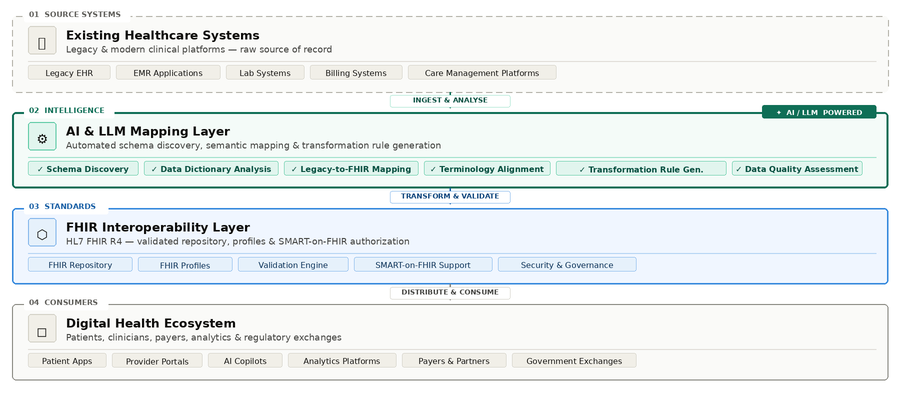
Rather than building a completely new middleware platform, organizations can consider implementing a lightweight FHIR overlay architecture.
In this model, existing EHR systems remain the system of record. AI-assisted mapping tools help translate legacy data structures into FHIR compliant resources, while a FHIR server or interoperability platform exposes standardized APIs to downstream applications.
The result is a more incremental modernization strategy that delivers interoperability without requiring a full replacement of existing systems.
Where AI Delivers the Most Value
Based on current capabilities, AI can provide meaningful acceleration in several areas:
- Schema and data model analysis
- Legacy-to-FHIR mapping generation
- Clinical terminology alignment
- Documentation and API specification creation
- Data quality assessment
- Gap analysis against FHIR profiles
- Test scenario generation
These are activities that traditionally consume substantial project effort and often become bottlenecks in interoperability programs.
Important Considerations
AI should be viewed as an accelerator, not a replacement for healthcare interoperability expertise.
Clinical accuracy, regulatory compliance, terminology management, security, privacy, and governance remain critical responsibilities that require human oversight.
Healthcare organizations must ensure that all AI generated mappings and transformations are reviewed and validated by qualified subject matter experts before production deployment.
Looking Ahead
The conversation is no longer whether healthcare organizations should pursue FHIR adoption. Regulatory requirements, patient expectations, digital health ecosystems, and AI-driven healthcare innovation are making interoperability a business necessity.
The more interesting question is how organizations can achieve interoperability faster and more efficiently.
AI-assisted FHIR enablement presents an opportunity to reduce implementation timelines, lower costs, and accelerate modernization efforts while leveraging existing EHR investments.
For healthcare leaders evaluating their interoperability roadmap, this may be the right time to explore how AI can complement traditional integration strategies and help unlock the next phase of digital transformation.
We would be interested to hear how others are approaching FHIR adoption and whether AI is already playing a role in your interoperability initiatives.