Drive Savings & Strategic Outcomes

Fuel Your Cloud Strategy with FinOps-Driven Visibility & Savings
As cloud adoption accelerates, managing costs becomes increasingly complex. With 80% of IT leaders struggling to control cloud spend (Flexera, 2022), the financial strain is real and growing.
The root of the challenge lies in the disconnect between cloud usage and business value. Without a structured financial operations (FinOps) model:
- Cloud services are treated as unchecked cost centers: This leads to uncontrolled spending and financial inefficiencies.
- Resources remain underutilized: Inefficient use of cloud resources results in wasted potential and higher costs.
- Innovation is throttled by inefficiencies: Financial constraints and lack of visibility hinder the ability to innovate and leverage cloud technologies effectively.
That’s where FinOps makes the difference. By unifying Finance, Engineering, and Business teams, it fosters shared ownership of cloud spending. The outcome? Informed decision-making, continuous collaboration, and a cost management approach that’s efficient, transparent, and aligned with business value.
OUR CAPABILITIES
Key Challenges of Traditional Cost Management
Traditional cost management practices fall short in today’s dynamic cloud environment.
Without FinOps, teams operate in silos, decisions are delayed, and cloud investments
go unchecked. Here’s why it’s needed:

Finance
Limited visibility and outdated reporting methods make it difficult to track and manage cloud spend effectively.

Engineering
Over-provisioned resources and lack of accountability lead to inefficiencies and higher costs.

Procurement
Complex pricing and billing structures create challenges in understanding and optimizing cloud expenses.

Product Teams
Difficulty linking cloud costs to business outcomes hinders the ability to measure the value and impact of cloud investments.

C-Suite
Reactive cost control strategies prevent innovation and strategic use of cloud resources.
Your Journey to FinOps Maturity
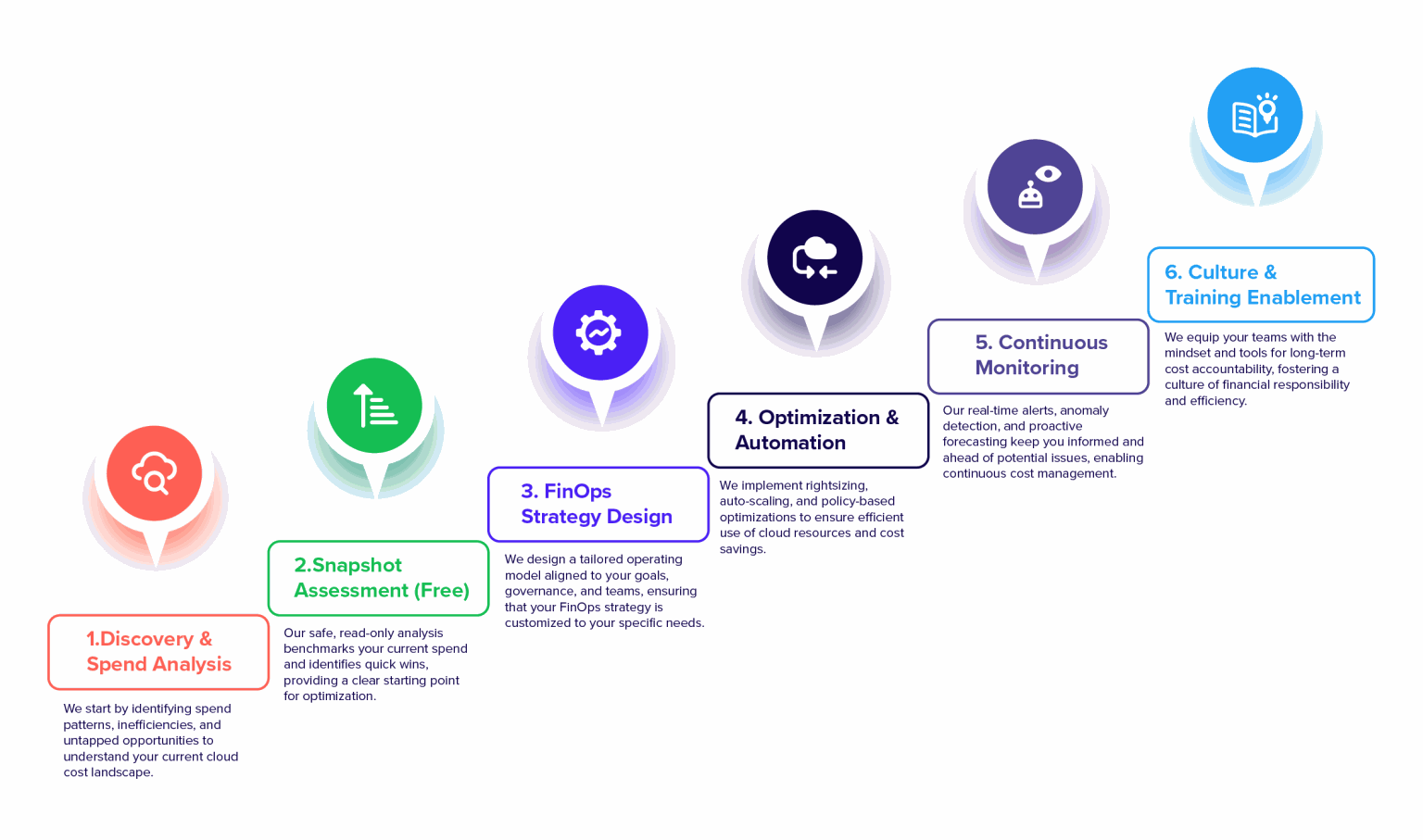
R Systems empowers organizations to move from cloud cost chaos to financial
clarity through a proven, scalable FinOps framework. Here’s how we guide
you through the journey:
Align Cloud Costs with
Business Goals Through FinOps
- Cost Visibility Before Deployment
- Built-in Cost Guardrails
- Automated Enforcement Through CI/CD
- Stronger Business Alignment
Cost Visibility Before Deployment
Forecast expenses with tools like InfraCost and native estimators to prevent surprises after provisioning.
Built-in Cost Guardrails
Apply budgets, restrict expensive services, and enforce mandatory tags directly through IaC templates.
Automated Enforcement Through CI/CD
Integrate cost validation, shutdown schedules, and approval workflows into your pipelines—stopping overspending before it happens.
Stronger Business Alignment
Every resource deployed is financially validated and tied to business outcomes, improving ROI and accountability.
FinOps Managed Services
R Systems offers Snapshot Services for a zero-risk entry into your FinOps journey
and Managed FinOps Services for continuous governance, cost control, and optimization
from Day 1.
01
Built-in guardrails & tagging policies
- Enforce compliance from the ground up.
02
Integrated governance in CI/CD & IaC
- Ensure cost control is part of every release cycle.
03
24/7 optimization & anomaly detection
- Proactive alerts for smarter financial decisions.
04
Custom dashboards & real-time reporting
- Visualize spend and performance with clarity.
05
Ongoing stakeholder alignment
- Keep engineering, finance, and leadership in sync.
Thinking that moves the industry
Lorem Ipsum is simply dummy text of the printing and typesetting industry. Lorem Ipsum has been the industry’s
standard dummy text ever since the 1500s, when an unknown printer took a galley of type and scrambled.

Can AI Help Healthcare Organizations Become FHIR-Ready Without Large Middleware Investments?
Read More
Can AI Help Healthcare Organizations Become FHIR-Ready Without Large Middleware Investments?
Read MoreCan AI Help Healthcare Organizations Become FHIR-Ready Without Large Middleware Investments?

Driving TV Monetization through targeted Addressable Advertising for Proximus Group
Read More
Driving TV Monetization through targeted Addressable Advertising for Proximus Group
Read MoreDriving TV Monetization through targeted Addressable Advertising for Proximus Group

Test smarter, deploy faster: How AI is reshaping Telecom validation beyond manual limits
Read More
Test smarter, deploy faster: How AI is reshaping Telecom validation beyond manual limits
Read MoreTest smarter, deploy faster: How AI is reshaping Telecom validation beyond manual limits
FAQs
How do we start our FinOps journey, and how disruptive is the initial assessment process to our existing operations?
You can begin safely with R Systems’ Zero-Risk Snapshot Service, a read-only, no-commitment assessment that delivers instant visibility into your cloud spending.
In less than two weeks we:
- Ingest billing data securely (AWS, Azure, or GCP — no production access)
- Analyze historical usage and forecast trends
- Identify “quick-hit” savings opportunities and FinOps maturity gaps
This non-intrusive scan has helped customers like a content-intelligence SaaS platform uncover 30%+ immediate savings and reach 95 % resource utilization without any disruption
What tooling do you use — do you rely on native cloud tools or third-party tooling?
We combine the best of both worlds:
- Native Tools: AWS Cost Explorer, AWS Budgets, Azure Cost Management, GCP Billing Exports
- Automation & Analytics Frameworks: InfraCost, Terraform + Ansible for policy-as-code, custom FinR dashboards, and our own FinOps automation accelerators
This hybrid approach ensures precise cost allocation, predictive forecasting, and continuous optimization across multi-cloud environments
How do you make sure cost savings last — not just a one-time cleanup?
We embed FinOps governance directly into your code and CI/CD pipelines using Infrastructure as Code (IaC).
Our “governance-by-design” model delivers:
- Pre-deployment cost visibility via InfraCost and native estimators
- Automated enforcement of cost policies, tagging rules, and shutdown schedules
- Built-in guardrails that block over-sized or non-budgeted resources
- Continuous optimization loops powered by predictive analytics and anomaly detection
That means cost control becomes part of your development lifecycle, sustaining 30–40 % savings long term
How will FinOps integrate with existing CloudOps/SRE processes?
FinOps operates as a cross-functional governance layer over your existing CloudOps/SRE frameworks.
We feed cost signals directly into runbooks, monitoring, and incident workflows so engineering, finance, and operations share a single view of cloud health and spend.
This enables real-time decisions—like pausing under-used resources or auto-rightsizing—without changing your operational tools or processes.
What kind of ROI or savings can we expect from R Systems FinOps?
Our FinOps programs routinely deliver 30–40 % cost reductions and measurable ROI within the first quarter.
Examples include:
- Healthcare Provider (Azure): $357 K annual savings and 40 % spend reduction
- Transit Software Company: 36 % cost cut and 95 % resource allocation accuracy
- Petabyte-Scale Content Platform: 36 % monthly savings and 30 % better budget forecasting
Clients typically achieve 100% spend visibility, 95 % resource utilization, and permanent budget alignment with business objectives.
How do you address compliance and security while optimizing costs?
very FinOps recommendation is validated against your security and regulatory frameworks — ISO 27001, SOC 2, GDPR, HIPAA.
We preserve data residency and encryption requirements while automating access controls and audit trails.
Cost changes that could impact data location or security posture are flagged and remediate before deployment.
This ensures you gain efficiency without compromising governance.
What makes R Systems different from other cloud FinOps providers?
R Systems combines automated governance, proven ROI, and zero-risk onboarding for mid-market enterprises.
Our differentiators:
- Free Snapshot Service for risk-free assessment
- FinR platform for continuous cost governance and real-time optimization
- Policy-as-Code and IaC integration for built-in guardrails
- Certified FinOps experts managing >$500 M in cloud spend across 100 + customers
- Proven results: Up to 40 % cost savings, 100 % spend visibility, 95 % resource utilization
In short: we turn cloud cost control into a continuous, automated discipline that lets you grow faster without spend chaos.
Let’s Co-Create the Future
of Education
Whether you’re designing a next-gen LMS, modernizing legacy platforms, or enabling AI-driven learning, R Systems is your strategic partner in building the education ecosystem of tomorrow.
#GPTWCERTIFIED
RSI is ‘Great Place To Work’® Certified™
We are Great Place To Work® Certified™ in 6 countries with a full-time workforce – India, the US, Canada, Mexico, Poland, and Moldova – each country individually acknowledging RSI as a preferred employer.